


 such that for all messages m ,
 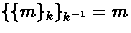 . (Note that for symmetric cryptography the decryption
key is the same as the encryption key, so
. (Note that for symmetric cryptography the decryption
key is the same as the encryption key, so  .)
.)
Let  denote the space of atomic messages.
The set of all messages
denote the space of atomic messages.
The set of all messages  over some set of atomic messages
is defined inductively as follows:
over some set of atomic messages
is defined inductively as follows:
 then
then  . (Any atomic
message is a message.)
. (Any atomic
message is a message.)
 and
and  then
then 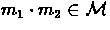 . (Two messages can be paired together to
form a new message.)
. (Two messages can be paired together to
form a new message.)
 and key
  then
then  . (A message M can be encrypted with key k to form a new
message.)
. (A message M can be encrypted with key k to form a new
message.)
Because keys have inverses, we take this space modulo the equivalence
. It is also important to note that
we make the following perfect encryption assumption. The only way to
generate  is from m and k . In other words, there do
not exist messages
is from m and k . In other words, there do
not exist messages  and
and  and key k such that
 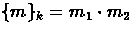 , and
, and 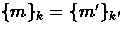 implies
m = m' and k = k' .
implies
m = m' and k = k' .
Let  be a subset of messages. The closure of
B (denoted
be a subset of messages. The closure of
B (denoted  ), representing the set of everything that
can be derived from B , is defined by the following rules:
), representing the set of everything that
can be derived from B , is defined by the following rules:
 then
then  .
. and
and  then
then 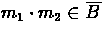 . (pairing)
then and
. (projection)
and key
. (pairing)
then and
. (projection)
and key  then
then  . (encryption)
and key
. (encryption)
and key  then . (decryption)