


The sorts we distinguish are  ,
,  ,
,  and
and  .There are (further unspecified) universes of constants for
the sorts and .We view (logical) formulas as being a subsort of the sort of messages,
since messages can also consist of nonces, timestamps or other constants,
drawn from some further unspecified universe,
as well as encrypted messages.
So there is an implicit injection
.There are (further unspecified) universes of constants for
the sorts and .We view (logical) formulas as being a subsort of the sort of messages,
since messages can also consist of nonces, timestamps or other constants,
drawn from some further unspecified universe,
as well as encrypted messages.
So there is an implicit injection  .
.
We use variables 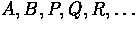 for principals,
Greek letters
for principals,
Greek letters  for formulas,
 for messages in general, and
  for keys.
For formulas, the language of the logic has the logical
constant  , the logical operators
  and
and  , and the operator = on the
sort .Furthermore we have the following operators:
, and the operator = on the
sort .Furthermore we have the following operators:

 , the logical-and operator, so that the
joining of two messages that happen to be formulas is interpreted
as their conjunction
, the logical-and operator, so that the
joining of two messages that happen to be formulas is interpreted
as their conjunction![[*]](../icons.gif/foot_motif.gif) )
)





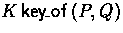 means that K is a good key between P and Q )

 denotes X encrypted with K by P )
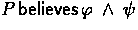 must be interpreted
as
must be interpreted
as 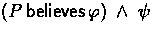 .
.
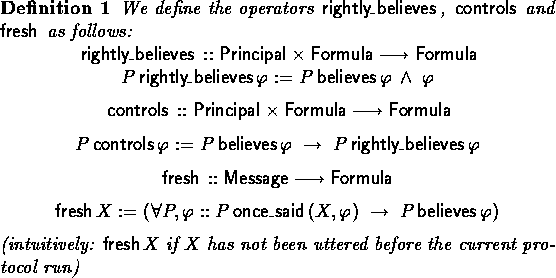
In BAN logic  and
and  are primitive
operators.
We could, equivalently, have introduced these operators as
primitives with their definitions turned into axioms.
are primitive
operators.
We could, equivalently, have introduced these operators as
primitives with their definitions turned into axioms.